

This is now the third time I’ve taken part in this, but every time you still can’t help but feel the nerves. Will I be able to do it? Especially as this time I’m also having to cope with a right hamstring that’s not quite playing ball. I remember very well the first time, how my heart was in my throat when we arrived at the site and reported to the camp commander. What on earth have I got myself into? By the end, you’re absolutely knackered, but still you find yourself asking straight away, ‘When’s the next one?’ Physically, it’s certainly tough, but the challenge is mainly mental. The event’s slogan is ‘expect the unexpected’. Do you dare to step out of your comfort zone and can you push yourself beyond your limits? That’s what it’s all about. And I’ve certainly learnt a great deal from that (and I’m still learning every day, by the way…) Getting comfortable with being uncomfortable, dealing with fears; these are all things we encounter in our work and daily lives too. Over the years, I’ve become more and more interested in mindset and mentality. Perhaps that’s why I enjoy (sporting) challenges like the Meet the Marines 24h Experience so much! Self-confidence, resilience, focus… it’s easy to draw parallels between sport and ‘life’ here.
Once again, it was definitely a real Experience (with a capital E); I’m secretly quite proud that we did it and that we were also the best team in our class.
And oh man, it was tough again. I certainly wasn’t in top form going in, with a niggling hamstring injury. Preparing for an event like this naturally involves both a mental and a physical aspect. So the physical preparation might not have been ideal, but you can always ask yourself when, in this life, things are ever actually perfect. That makes the mental preparation perhaps all the more important. Especially when you know in advance that it’s going to be tough or difficult, and you’re feeling a lot of tension, nerves, or perhaps even fear. Instead of fighting that negative feeling, I try to embrace it. Do you feel that proverbial knot in your stomach or that tightness in your chest? Embrace it as an old friend. It’s your body’s way of preparing you for what might lie ahead, so it’s actually not a negative feeling at all – it’s actually very positive! Your body is ready! Get comfortable with being uncomfortable! Whenever I feel this, I always try to stay very mindful of my breathing, consciously breathing into my stomach rather than my chest; breathing out twice as long as I breathe in, and very consciously relaxing my jaw and stomach.
From the moment the starting signal sounded, you’re immediately swept up in the chaos of the missions you have to complete as a team. You have no idea what to expect – it’s not for nothing that the motto is ‘Expect the unexpected’! Here, too, my breathing really helped me to stay in the here and now. Worrying about what might still be to come has a hugely negative effect. Whenever I caught myself thinking things like ‘How much longer is this going to last?’ or started dwelling too much on where exactly in my body it was hurting, I’d immediately try to refocus on my breathing and ‘ground’ myself in the here and now by literally feeling my feet on the ground. At one point, at around 4 o’clock in the morning, we were roused from our tents by air raid sirens and fireworks, and we had to set off at full speed, away from the camp. During this forced march, I saw the sun beginning to rise on the horizon, and then I literally said to myself a few times, ‘You are here, now.’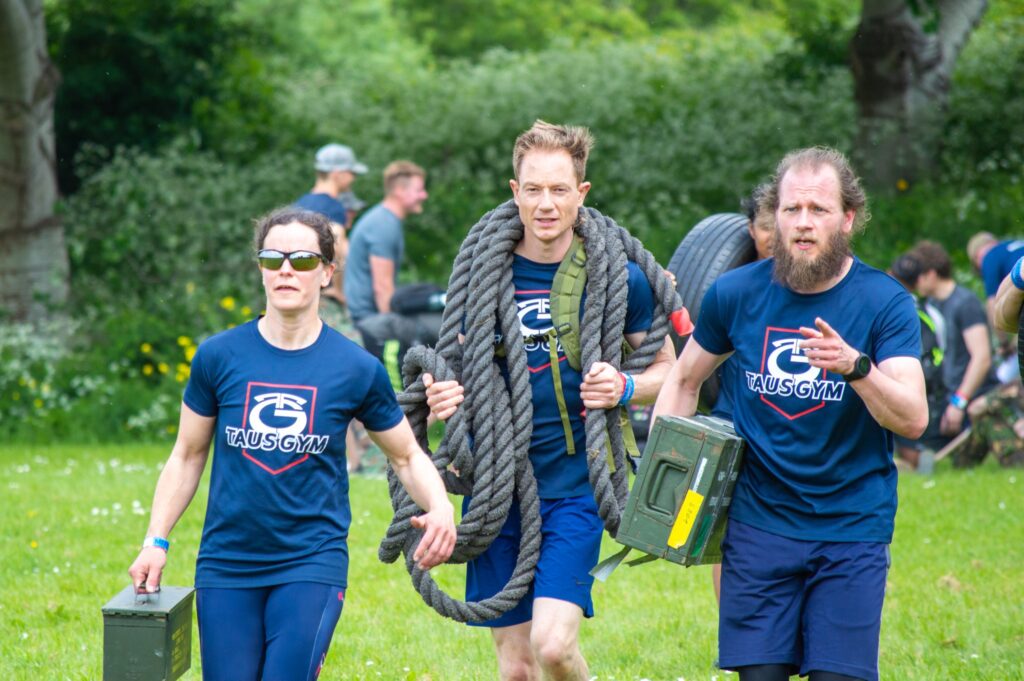
This can also really help you reach that mental ‘turning point’, allowing you to shift from negative thinking back to positive and strong thinking. And especially as I really struggled during this edition, both mentally and physically, I noticed that I still find it so incredibly special every time that mental turning point arrives. How quickly or easily you can reach that turning point for yourself is, in my view, an important part of being mentally strong. So why not try to identify what it is that helps you start thinking positively and strongly again? For me personally, I’ve noticed that – alongside the breathing exercises and ‘grounding’ techniques I mentioned above – the words and energy of others also have a huge influence on me. Of course, this can very easily become a pitfall (for example, when you’re really drawn to other people’s negative opinions and let yourself be dragged into a downward spiral; yep, I do that too!), but that’s the funny thing about all your strengths: too much of a good thing can become a pitfall, but if you know how to harness them properly, they become your strengths! So when the race director paid us a compliment on our efforts, or when I felt the energy as everyone shouted ‘Yells’ together, I can really use that to recharge myself. Routine is also important to me: if I have a quick moment to myself to make sure all my kit is in order, to check I’ve had enough to drink and, for example, to put on some blister plasters, muscle gel or something similar, then I can tell both my body and my mind that I’m ready for whatever’s coming! (There’s a pitfall here too: if you’re too rigid in your routines, you can become mentally inflexible and unable to react appropriately to what’s happening here and now). At one point, after a mission where we had to collect materials at specific coordinates to make a fire, and then had to be the quickest to get the fire going, and we were all allowed to sit round the lovely warm fire for a while, I was able to take a moment for myself, for example, to (literally and figuratively) catch my breath and ground myself.
The other missions we were allowed to carry out – such as a stress drill Running and shooting, a rowing challenge, a river crossing where you had to get under or over a rope, and building a shelter and (learning to) filter water at night in the dark – were all really cool again.
And that’s what’s so brilliant about events like this 24-hour race, where you have to push your limits and step out of your comfort zone: you always learn so much about yourself. And that certainly makes me feel quite humble and grateful. And that’s why – even though it was really tough at times and I definitely found myself thinking, ‘Why am I doing this?’ and ‘This really was the last time’ – you just want to come straight back again next year!!
Kind regards,
Jeannette Martens